
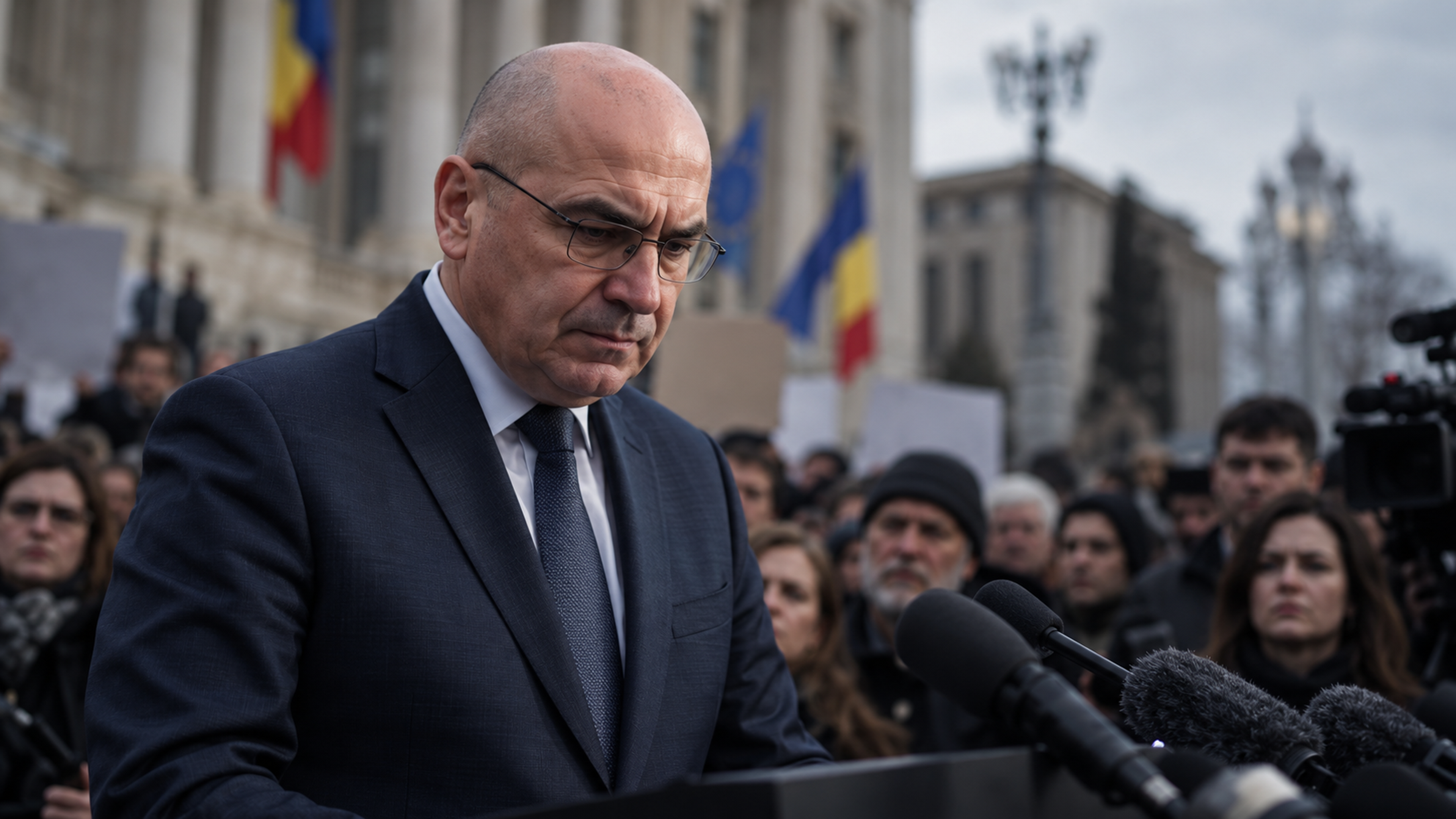
Ilie Bolojan: Political Pressure and Critical Windows
Original publicationKey signal
Ilie Bolojan’s political vulnerability may emerge first through communication and public perception, then intensify through legal and political pressure. The analysis identifies distinct temporal windows in which reputational damage, accusations and challenges to his governing position could become increasingly consequential.
Analysis
Communication as the first vulnerability
The analysis begins with a relatively narrow but clearly defined period extending from 11 August to 23 October 2025. During this interval, communication is identified as the principal source of vulnerability for Ilie Bolojan.
The risk is presented in two forms. The first concerns Bolojan’s own communication: the possibility that his statements, tone or way of expressing policy decisions may be misunderstood, interpreted negatively or fail to produce the intended public response. The second concerns communication generated by others about him — political opponents, institutions, public actors or broader public reactions capable of placing his image under pressure.
The emphasis is therefore not limited to formal political decisions. Public perception itself becomes part of the analytical field. A protest, hostile parliamentary reaction, criticism amplified through the media or a controversy surrounding the interpretation of his actions can all function as manifestations of the same underlying vulnerability.
The article deliberately illustrates this point through the possibility of Bolojan being booed in Parliament on 1 September 2025, the date of publication. Such an event is treated not simply as political opposition but as a visible form of communication between political authority and the public environment around it.
From reputational pressure to accusations
The second part of the analysis identifies a substantially more difficult period extending from 5 January to 17 June 2026.
Unlike the first window, which is primarily concerned with communication and public image, this later interval shifts the analytical focus toward accusations and potential legal or political exposure.
The period is divided into two distinct phases.
From 5 January until 17 March 2026, the analysis anticipates the possibility of accusations — including potentially criminal accusations — connected to actions predating Bolojan’s period as interim president and, subsequently, prime minister.
The distinction is important. The hypothesis does not necessarily imply that such accusations would be proven, nor does it predict a particular judicial outcome. It identifies a period in which earlier stages of Bolojan’s public activity could become a source of renewed scrutiny, allegations or institutional pressure.
The critical window: 17 March–17 June 2026
The analysis identifies the period from 17 March to 17 June 2026 as the most dangerous phase.
The nature of the anticipated pressure changes here. Whereas the previous stage concerns possible accusations connected to earlier activity, this second phase concerns the possibility that allegations may relate directly to decisions or actions undertaken during Bolojan’s current national mandate.
This distinction increases the potential political significance of the period. Accusations concerning current governmental activity can affect not only personal reputation but also authority, coalition stability, institutional legitimacy and the ability to continue governing.
The analytical hypothesis is therefore progressive: communication pressure may first weaken or complicate public perception; subsequent scrutiny may revive questions about previous activity; and finally, pressure connected directly to the current mandate may create more immediate political consequences.
A sequence rather than a single prediction
The structure of the analysis is chronological rather than event-specific. It does not identify one predetermined scandal, accusation or institutional outcome. Instead, it proposes a sequence of changing vulnerabilities:
11 August–23 October 2025: communication, interpretation and public image.
5 January–17 March 2026: possible accusations, including criminal ones, associated with activity predating the current national mandate.
17 March–17 June 2026: a more critical period in which accusations may concern actions undertaken during the current mandate.
The analytical value of these windows lies in their separation. Subsequent events should therefore be assessed not only by whether pressure occurred, but also by its nature: communication and reputational pressure should be distinguished from allegations concerning earlier activity, and both should be distinguished from challenges directly connected to the exercise of the current mandate.
Analytical proposition
The central proposition is that Bolojan’s vulnerability may develop in stages rather than through a single political event. The first stage concerns the way in which his actions and messages are received. The later stages concern progressively more consequential forms of scrutiny, culminating in a period in which political and legal pressure could directly affect his governing position.
For this reason, the analysis should ultimately be evaluated against both timing and type of event. A development occurring within a predicted interval is not, by timing alone, sufficient to establish correspondence; its subject and character should also be compared with the original distinction between communication risk, accusations related to earlier activity and accusations connected to the current mandate.
Forecast
Status
OpenKey windows
| 11 Aug 2025 – 23 Oct 2025 | Communication and public perceptionPrimary vulnerability through Bolojan’s own communication, the way his statements are interpreted, and public or political communication about him that may affect his image. |
| 05 Jan 2026 – 17 Mar 2026 | Accusations linked to earlier activityWindow for possible accusations, including potentially criminal allegations, connected to actions predating his current national mandate. |
| 17 Mar 2026 – 17 Jun 2026 | Current-mandate political and legal pressureThe most critical window, in which accusations or institutional pressure may relate directly to decisions or actions undertaken during his current mandate. |
Key points to watch
- Public communication and message interpretation
- Political and parliamentary reactions
- Reputational pressure and public perception
- Accusations linked to earlier public activity
- Legal or institutional scrutiny
- Pressure connected to decisions taken during the current mandate
Disclaimer
These windows should be assessed by both timing and the nature of the developments that occur within them. Communication pressure, allegations concerning earlier activity and pressure linked to decisions taken during the current mandate represent distinct analytical phases and should not be treated as interchangeable forms of confirmation.
Developments
- Bolojan questioned by DNA as a witness in the Fănel Bogoș case. Ilie Bolojan was questioned for more than two hours by prosecutors at DNA Iași as a witness in the Fănel Bogoș case. According to the Government, the hearing concerned the circumstances of the 23 September 2025 meeting Bolojan had granted to Bogoș. The hearing occurred well after the original forecast windows and should therefore be treated as a later consequence rather than a temporal confirmation. Digi 24
- PSD raises influence-peddling allegations linked to current government decisions. PSD publicly alleged influence peddling and a conflict of interest surrounding government decisions connected to the EU SAFE defence-financing programme and the selection of legal advisers. The allegations concerned activity during Bolojan’s current national mandate and appeared within the 17 March–17 June window identified for pressure linked directly to current-office decisions. AGERPRESS
- Bolojan government falls after no-confidence vote. Romania’s Parliament adopted a no-confidence motion against the government led by Ilie Bolojan with 281 votes in favour. The vote ended the government’s full mandate and represented the most consequential political development occurring inside the 17 March–17 June critical window identified in the original analysis. AGERPRESS
View all developments
- PSD ministers resign and the government loses its parliamentary majority. PSD ministers submitted their resignations from the Bolojan government, formally implementing the party’s withdrawal of political support. PSD stated that the prime minister no longer had the support of a parliamentary majority, substantially increasing the institutional pressure on his government. AGERPRESS
- PSD withdraws political support for Ilie Bolojan. PSD members voted overwhelmingly to withdraw political support from Prime Minister Ilie Bolojan, with 97.7% supporting withdrawal. The decision sharply weakened his parliamentary position during the 17 March–17 June period identified as the most critical phase of the original analysis. HotNews
- Prison-system unions file criminal complaint against Bolojan. Trade unions representing prison-system employees announced a criminal complaint against Prime Minister Ilie Bolojan, alleging abuse of office in connection with the government’s public-administration reform. The complaint fell inside the 5 January–17 March analytical window, although it concerned actions of the current government rather than activity predating his national mandate. HotNews
- Court of Accounts publishes critical audit of Bihor County’s 2024 finances. Romania’s Court of Accounts published its financial audit of Bihor County for 2024, covering a period associated with Bolojan’s earlier local and county-level political activity. The audit identified financial reporting and compliance deficiencies. It constituted institutional scrutiny of an earlier administrative period, but not a criminal charge against Bolojan personally. Romanian Court of Accounts
- Bogoș case brings the September meeting under public scrutiny. After DNA proceedings involving Fănel Bogoș became public, the previously undisclosed 23 September meeting at Victoria Palace became a subject of political and media scrutiny. The Government subsequently confirmed the meeting and described its circumstances. AGERPRESS
- Coalition dispute centres on political communication and public confidence. On the final day of the first analytical window, Bolojan publicly warned that statements made by PSD leader Sorin Grindeanu could produce both economic consequences and problems of public confidence. The exchange reflected the communication and perception pressures identified for the 11 August–23 October period. HotNews
- Bolojan meets Fănel Bogoș at Victoria Palace. Prime Minister Ilie Bolojan met PNL Vaslui leader Mihai Barbu and businessman Fănel Bogoș at Victoria Palace. According to the Government, the meeting lasted approximately 15 minutes. Its significance emerged later, after Bogoș became the subject of a DNA investigation. AGERPRESS
- Parliamentary protest interrupts Bolojan’s presentation of government measures. On the day the original analysis was published, AUR members protested in Parliament while Ilie Bolojan presented the measures for which his government was assuming responsibility. MPs displayed critical messages and shouted toward the prime minister, creating an immediate public manifestation of the communication and perception risk identified in the analysis. Hotnews
Sources
- Original publication: Ilie Bolojan — Critical Analysis