
Poland: Two Years of Negotiation and Domestic Diplomacy
Original publicationKey signal
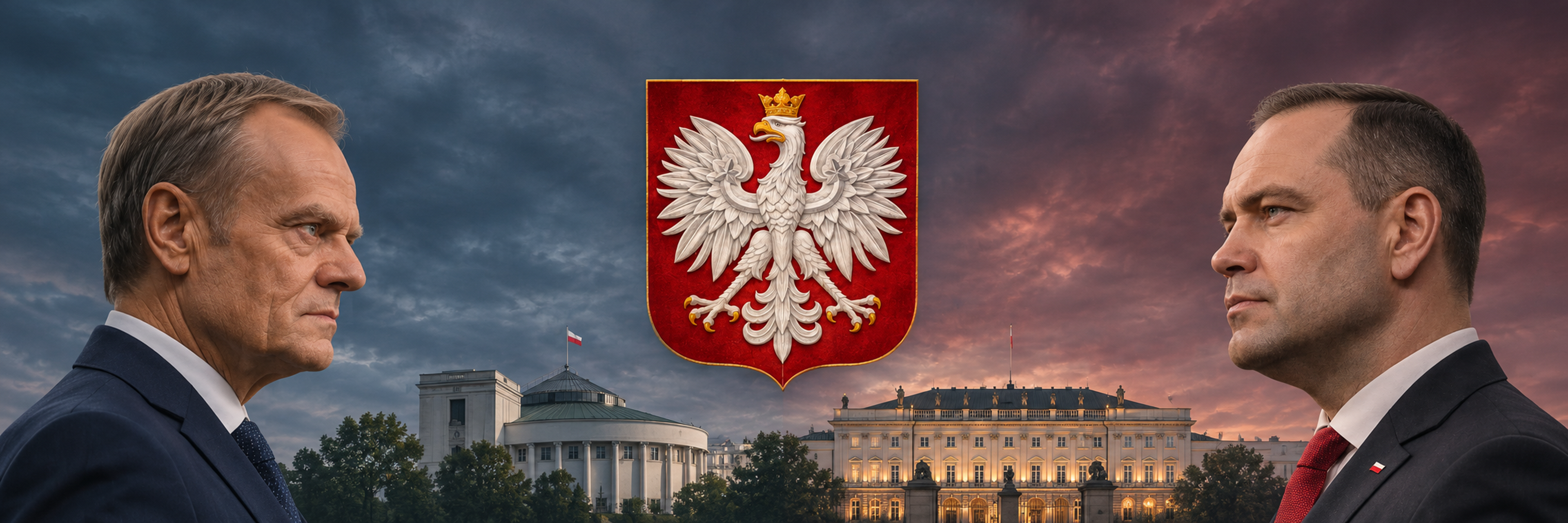
The institutional confrontation of 30 October 2026 marks the beginning of a projected two-year period in which Poland's political forces may be compelled to redefine their relationships and balance of power. At its centre is the relationship between Prime Minister Donald Tusk and President Karol Nawrocki. The analysis examines whether the resulting institutional tensions will be resolved through domestic diplomacy or confrontation, within a forecast horizon extending to 11 November 2028.
Analysis
The 30 October 2026 institutional trigger
The events of 30 October 2026, marked by an escalation of the dispute surrounding Poland's Constitutional Tribunal, are interpreted as the opening of a period during which political, social and domestic intelligence structures may face increasing pressure to recalibrate their positions and influence. The process could unfold through negotiation and institutional accommodation, or through direct confrontation. Medium
The central actors are Donald Tusk and Karol Nawrocki, whose political coexistence may become a defining test of Poland's institutional stability. Their ability to negotiate a workable relationship will influence the country's internal balance of power throughout the projected period. Medium
Smolensk as an unresolved historical reference
Alongside the analysis of the two leaders, the Smolensk air disaster of 10 April 2010 provides an additional historical reference. More than sixteen years later, the tragedy continues to divide Polish society, while the criminal investigation into its causes and circumstances has not been definitively concluded. The aircraft wreckage remains in the possession of the Russian Federation, and Polish authorities reported in 2026 that access to its storage site was unavailable. The disaster profoundly changed Poland's political leadership and left a historical legacy whose consequences remain relevant. Medium
A further historical dimension arises from Nawrocki's former leadership of the Institute of National Remembrance (IPN), which holds sensitive archives from Poland's communist period. Documents concerning the Solidarity movement, in which Tusk participated, could regain political relevance. This possibility does not establish that Nawrocki has accessed or used any particular records against the prime minister. Medium
November and December 2026 as the first public test
11 November 2026, Poland's Independence Day, may become an early moment of public confrontation between Tusk and Nawrocki. Separate commemorations or politically contrasting speeches at a shared event could reveal the direction of their relationship. The forecast assigns Nawrocki a greater potential to mobilise national support on this occasion, with a public address that could overshadow Tusk's. Medium
The period 16 November–26 December 2026 represents a heightened tension window in which sensitive information concerning Donald Tusk's past could enter public debate, potentially creating political and reputational vulnerabilities. This is a forecast scenario rather than an assertion that such information exists or that future allegations would be substantiated. Medium
Donald Tusk and the resilience of political power
For Donald Tusk, the period extending to 11 May 2027 indicates a comparatively strong potential to retain the premiership. His position appears difficult to destabilise during this interval, although a voluntary resignation remains one possible scenario for an earlier departure. Beyond this date, the preservation of his authority may depend increasingly on political negotiation and the continued support of his allies. Medium
If these alliances weaken, Tusk could enter a phase of declining political authority, with a particularly sensitive window between 22 October and 22 December 2027. During this period, political allegations, should they arise, could develop into formal complaints or judicial proceedings. The projection does not imply wrongdoing or anticipate a judicial finding. Medium
Karol Nawrocki and the black chess pieces
From late 2026 until 31 July 2027, Nawrocki's position resembles that of a chess player moving the black pieces. Rather than initiating every confrontation, he may benefit from observing Tusk's decisions and capitalising on political miscalculations. Other political or institutional actors could contribute to strengthening the president's position without necessarily acting under his direction. Medium
This relatively advantageous position may change during 1 August–30 September 2027, a period identified as a possible window of personal vulnerability for Nawrocki. The forecast encompasses accidents, incidents affecting his physical safety and, in the most serious scenario, an attempted attack. The assessment does not establish the existence of any specific or verified threat. Medium
The 2027 parliamentary election period
The anticipated parliamentary elections of October–November 2027 could intensify tensions between Poland's two centres of political power. If Tusk and Nawrocki enter the campaign without having negotiated workable terms of institutional coexistence, the electoral process may be accompanied by heightened polarisation, public protests and intensified social mobilisation. Medium
A possible reopening of the Smolensk investigation
Between 11 November 2027 and 11 May 2028, the analysis identifies an elevated potential for the Smolensk investigation to be reopened or substantially renewed. Further inquiries could reveal previously unknown evidence, material insufficiently examined in earlier investigations or information whose alleged concealment would require substantiation. Medium
Such a development could contribute to closing the historical window opened by the disaster on 10 April 2010, through a clearer understanding of an event that profoundly altered Poland's political leadership and institutional trajectory. Medium
Analytical synthesis
For Poland and its citizens, negotiation and domestic diplomacy remain the preferable path. If this approach is rejected or proves unsuccessful, the confrontation between the political camps represented by the president and prime minister could temporarily affect social stability and accelerate a wider institutional recalibration. Medium
The broader forecast window closes on 11 November 2028. By then, Poland may have reached a different internal balance of power. The central question is whether that equilibrium will emerge through domestic diplomacy or through the force of events. Medium
Forecast
Status
OpenKey windows
| 30 October 2026 – 11 November 2028 | Institutional recalibrationA two-year observation window during which Poland's political and institutional balance may be reshaped through negotiation, domestic diplomacy or confrontation. |
| 11 November 2026 | First public confrontationIndependence Day commemorations may reveal contrasting political positions, with Karol Nawrocki potentially attracting stronger national support than Donald Tusk. |
| 16 November – 26 December 2026 | Donald Tusk: reputational vulnerabilityPossible emergence of sensitive information concerning Tusk's past, with potential political and reputational consequences. |
| November 2026 – 31 July 2027 | Karol Nawrocki: strategic positioningA comparatively advantageous period in which the president may benefit from responding to the prime minister's decisions, political difficulties and potential miscalculations. |
| November 2026 – 11 May 2027 | Donald Tusk: political resilienceA period of comparatively strong potential for continuity in office, followed by increasing dependence on coalition stability and political negotiations. |
| 1 August 2027 – 30 September 2027 | Karol Nawrocki: personal vulnerabilityA forecast window concerning potential accidents or incidents affecting the president's physical safety, including the theoretical scenario of an attempted attack. No specific threat has been verified. |
| 14 October 2027 – 12 November 2027 | Parliamentary elections and social mobilisationPotential intensification of political confrontation, public polarisation and social mobilisation if institutional coexistence remains unresolved. |
| 22 October 2027 – 22 December 2027 | Donald Tusk: maximum political vulnerabilityPotential escalation of political allegations into formal complaints or judicial proceedings, particularly if the prime minister's political alliances weaken. |
| 11 November 2027 – 11 May 2028 | Smolensk: renewed investigationPotential reopening or substantial renewal of investigations into the 2010 Smolensk air disaster, with the possible emergence of new or previously insufficiently examined evidence. |
Key points to watch
- 1. The organisation and political messages of Independence Day commemorations on 11 November 2026.
- 2. Any disclosures concerning Donald Tusk's past and their independent verification.
- 3. The stability of Tusk's political alliances after 11 May 2027.
- 4. Nawrocki's political positioning through July 2027 and verified security developments in August–September 2027.
- 5. The intensity of social mobilisation during the 2027 parliamentary campaign.
- 6. Any formal legal proceedings involving political allegations in late 2027.
- 7. Official decisions concerning the Smolensk investigation, including developments related to the aircraft wreckage.
Disclaimer
The observation windows overlap because they track distinct but interconnected political and institutional processes. The broader period from 30 October 2026 to 11 November 2028 defines the overall forecast horizon, while the shorter windows identify potential turning points involving Donald Tusk, Karol Nawrocki, the 2027 parliamentary elections and the unresolved Smolensk investigation. These windows should be assessed collectively, rather than as isolated or predetermined events.
Developments
- Poland’s Independence Day: Separate Ceremonies, Public Confrontation and a Constitutional Court Reset. On 11 November 2026, the date specifically identified in Noetic Eye’s analysis published on 4 November, Poland’s President Karol Nawrocki and Prime Minister Donald Tusk participated in separate Independence Day ceremonies. Nawrocki addressed the central celebrations in Warsaw, while Tusk attended an event in Szczecin. The sequence of their public statements was particularly significant. During the morning ceremony in Szczecin, Tusk publicly invited Nawrocki and his family to his home in Sopot for a meeting before Christmas, proposing a direct conversation aimed at overcoming political divisions. Later that day, Nawrocki used his Independence Day address to call for the rebuilding of Poland’s Constitutional Tribunal through a joint institutional effort. He argued that constitutional institutions should remain outside political disputes and that the Tribunal should serve the Constitution and the state rather than successive parliamentary majorities. His call for a Tribunal free from political influence placed the institution at the centre of the national debate. The presidential address generated immediate political reactions. Tusk publicly criticised the speech, while other government representatives challenged its political tone. At the Warsaw ceremony, Nawrocki received audible expressions of support, including chants of his name. His subsequent participation in the large Independence March reinforced his public visibility, although the march’s attendance cannot be attributed solely to his personal political appeal. Forecast correspondence: Noetic Eye’s analysis identified 11 November 2026 as a potential moment of public tension between the two leaders, anticipating separate ceremonies with competing national messages or a joint event marked by political confrontation. It also highlighted Nawrocki’s potential for heightened public mobilisation and a presidential address capable of overshadowing the prime minister’s intervention. The separate ceremonies, public confrontation and strong reactions to Nawrocki’s address provide documented correspondence with important elements of that forecast. However, the extent to which the presidential intervention eclipsed Tusk’s nationally cannot yet be established through comparable audience or public-opinion data. Strategic significance: The chronology reveals a notable distinction between the two leaders’ public positions. Tusk offered a framework for dialogue; Nawrocki articulated an institutional objective around which future negotiations might be organised. This is consistent with a competition to shape the terms of political coexistence, although the sequence alone does not establish that Nawrocki’s speech was a direct response to Tusk’s invitation. The events of 11 November illustrate the simultaneous emergence of confrontation and declared openness to institutional dialogue. Whether these public positions will develop into substantive negotiations remains an open question. The forecast remains under observation. Presidency of Poland
Sources
- Original publication: Poland: Two Years of Negotiation and Domestic Diplomacy