
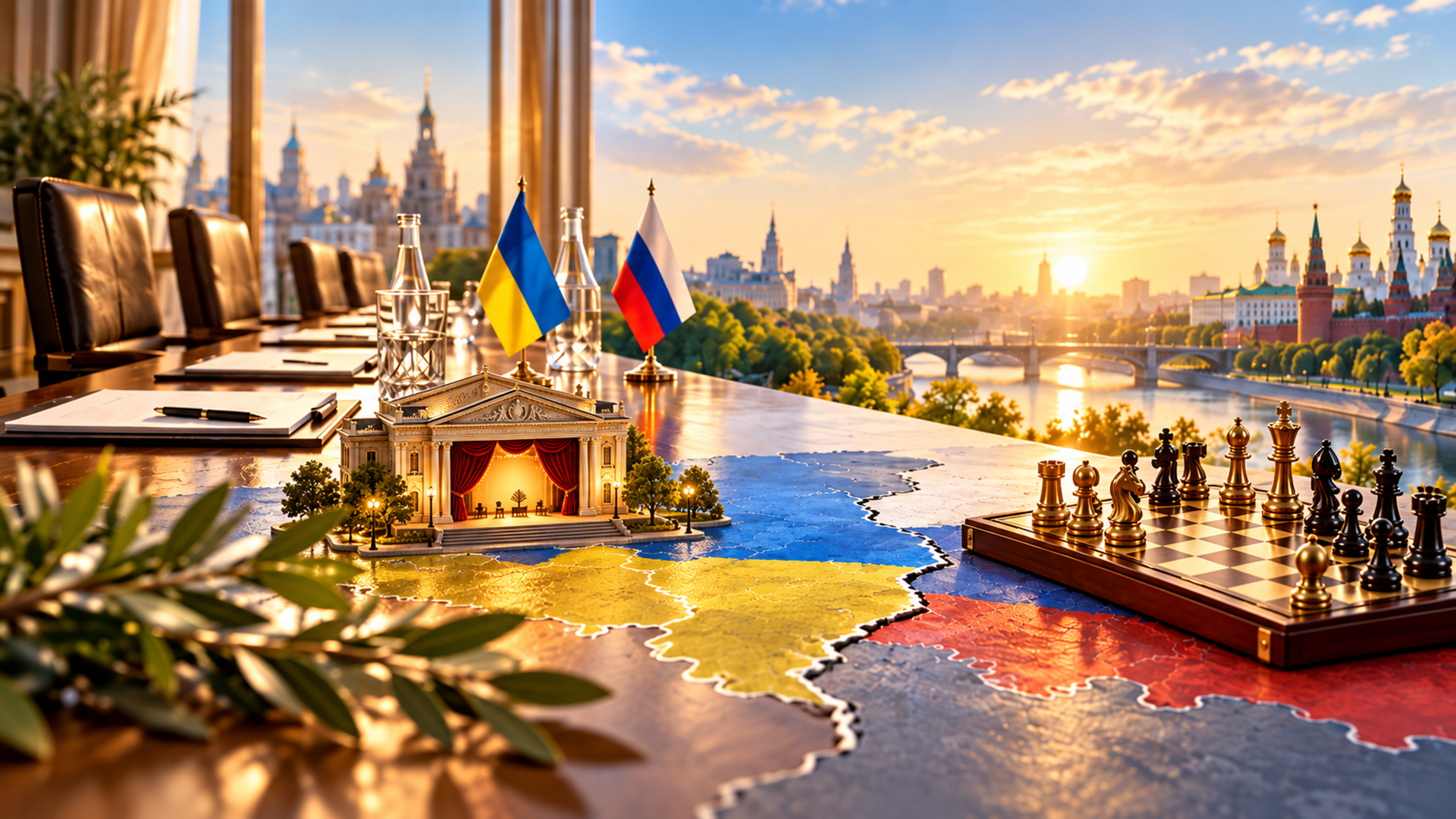
Key signal
The decisive signal is whether the failure of peace efforts in June 2025 marks the closing of a realistic settlement window. If no political breakthrough is secured in 2025, the Russia–Ukraine war is more likely to shift into a prolonged strategic cycle extending toward 2028, with diplomacy remaining active but unable by itself to end the conflict.
Analysis
War as a framework for a future settlement
The analysis begins from an unconventional interpretation of the Russia–Ukraine war. It proposes that, beneath the military confrontation, there may also exist a longer-term political logic aimed at establishing a new relationship between Russia and Ukraine.
Within this interpretation, Ukraine could ultimately acquire a particular buffer status between Russia and NATO, giving it greater autonomy in relation to competing geopolitical centres of power. The original article also argues that the United States, France and NATO had opposed an earlier form of settlement acceptable to the Ukrainian and Russian leaderships. These propositions represent the author’s analytical framing and should be distinguished from the subsequent, date-specific forecasts. Medium
A peace opportunity extending into 2025
The central forecast identifies 24 August 2024–12 June 2025 as the most favourable period for Russia and Ukraine to find a peace solution together.
This is the broadest and most important temporal window in the analysis. It does not imply that negotiations must begin on 24 August or that an agreement must wait until June 2025. Rather, the entire interval is treated as an elevated opportunity for diplomacy capable of producing a negotiated settlement. Medium
The significance of 12 June 2025 is therefore greater than that of an ordinary forecast end date. It functions as a decision threshold between two possible trajectories: settlement within the identified opportunity window, or movement toward a substantially longer conflict.
Negotiations after 10 October 2024
Within the broader peace window, the analysis identifies a more specific diplomatic threshold: a very high potential for peace negotiations to begin after 10 October 2024. Medium
This proposition should be evaluated against actual diplomatic activity rather than general public statements about peace. Relevant evidence would include direct or mediated negotiations, formal peace initiatives, ceasefire frameworks, high-level diplomatic contacts or other processes designed specifically to move the parties toward an end to the war.
The date represents an opening threshold rather than a one-day prediction. Developments beginning shortly after 10 October therefore remain relevant if they correspond materially to a genuine negotiation process.
The last week of December as the strongest treaty window
The original article becomes more specific when it identifies the last week of December 2024 as the best period for signing a peace treaty. Medium
This is analytically different from the October forecast. October concerns the potential beginning of negotiations; late December concerns the potential conclusion of an agreement.
The distinction is important. A ceasefire proposal, diplomatic initiative or temporary truce during this period may demonstrate that the window had elevated diplomatic relevance, but it should not automatically be treated as equivalent to the peace treaty anticipated in the original analysis.
The article also introduces a directional consequence if this window is missed: Russia would begin to gain progressively greater advantages in subsequent negotiations. Medium
Delaying the conclusion into 2025
The analysis anticipates that both Vladimir Putin and Volodymyr Zelenskyy would prefer to delay the conclusion of peace discussions into 2025.
For Putin, the forecast is more specific, identifying February 2025 as an important delay threshold, following his 72nd birthday. Medium
This does not necessarily predict that peace would be concluded in February. Instead, February represents a point after which the Russian leadership may become more willing to move toward the decisive phase of negotiations.
The distinction between beginning negotiations, delaying their conclusion, and actually concluding a peace settlement is therefore fundamental to evaluating the forecast.
Russia’s April 2025 negotiation threshold
The analysis separately states that Russia would try to conclude the peace negotiations by 30 April 2025. Medium
This introduces another measurable threshold inside the broader August 2024–June 2025 peace window.
The forecast should not be interpreted as guaranteeing a treaty by 30 April. The wording concerns Russia’s expected effort or preference to bring the negotiation process toward conclusion by that point.
For subsequent evaluation, the key question is whether Russian diplomatic behaviour, proposals or negotiation activity around this period demonstrated an attempt to move toward a settlement, and whether such an effort succeeded or failed.
The 12 June 2025 decision point
The broad peace window ends on 12 June 2025.
This date is central because the article explicitly creates a conditional scenario:
If Russia and Ukraine fail to find a peace solution during the period ending on 12 June, the conflict is expected to move into a much longer trajectory. Medium
The analytical importance of this threshold therefore lies not simply in whether fighting continues for several days or months beyond it. The more meaningful test is whether the peace process fails to produce an agreement by the end of the identified window and whether the conflict subsequently demonstrates characteristics of a prolonged war.
Alternative scenario: war into 2027–2028
If the 2024–2025 peace opportunity is missed, the analysis anticipates that the war could continue until the fourth quarter of 2027 or even into 2028. Medium
This is not an independent prediction detached from the earlier window. It is explicitly conditional upon the failure of the peace scenario.
The analysis therefore has a branching structure:
Peace within the 24 August 2024–12 June 2025 opportunity window, or, if that fails, a prolonged conflict extending toward late 2027 or 2028.
This conditional structure is essential for later evaluation. The long-war scenario cannot be considered confirmed merely because peace was not achieved in 2025; it remains an open forecast until its stated horizon is reached.
A wider regional risk in 2027–2028
The analysis adds another long-range proposition concerning the 2027–2028 period.
It describes those years as unusually eventful for both Russia and Ukraine and raises the possibility that both countries could be drawn into a regional conflict that is not originally their own. Medium
This proposition should be treated separately from the continuation of the current war. A Russia–Ukraine conflict still continuing in 2028 would address the long-war scenario, while involvement of both states in a different regional confrontation would constitute an additional and distinct forecast.
Analytical proposition
The analysis ultimately describes a sequence rather than a single prediction. A broad peace opportunity opens between 24 August 2024 and 12 June 2025. Within that period, negotiations become particularly probable after 10 October 2024, the last week of December 2024 represents the strongest opportunity for a treaty, February 2025 represents an important Russian delay threshold, and 30 April 2025 marks a possible Russian target for concluding negotiations.
If those opportunities fail to produce peace by 12 June 2025, the analysis shifts to its alternative scenario: a prolonged Russia–Ukraine war extending toward Q4 2027 or 2028, potentially accompanied by a wider regional-security crisis involving both countries.
Forecast
Status
OpenKey windows
| 24 Aug 2024 – 12 Jun 2025 | Primary peace opportunityThe analysis identifies this period as the strongest overall window for Russia and Ukraine to find a negotiated peace solution. |
| 10 Oct 2024 | Opening of peace negotiationsA high-potential threshold after which meaningful peace negotiations are expected to become increasingly possible. |
| 25 Dec 2024 – 31 Dec 2024 | Best treaty-signing windowThe last week of December 2024 is identified as the strongest period for concluding and signing a peace agreement. |
| Feb 2025 | Russian delay thresholdThe analysis identifies February 2025 as an important point after which Vladimir Putin may become more inclined to move toward the decisive phase of negotiations. |
| 30 Apr 2025 | Russian negotiation targetRussia is expected to seek conclusion of the peace negotiations by approximately 30 April 2025. |
| 12 Jun 2025 – Q4 2027 / 2028 | Prolonged-war scenarioIf no peace solution is reached by the end of the primary window, the analysis shifts to an alternative scenario in which the war may continue into late 2027 or 2028. |
Key points to watch
- Opening of meaningful Russia–Ukraine peace negotiations
- Progress toward a ceasefire or formal peace framework
- Changes in Russia’s negotiating leverage after December 2024
- Whether negotiations move toward conclusion by April–June 2025
- Evidence that failure of the 2025 peace window is shifting the war toward a prolonged 2027–2028 scenario
Disclaimer
The forecast is structured as a sequence of diplomatic thresholds within a broader peace window. The 2027–2028 scenario is conditional rather than independent: it becomes relevant only if the 24 August 2024–12 June 2025 period fails to produce a durable settlement. Negotiation milestones, ceasefire initiatives and a final peace agreement should therefore be assessed separately.
Developments
- Russia and Ukraine resume direct negotiations after more than three years. Russian and Ukrainian delegations met directly in Istanbul for the first time since the early months of the 2022 invasion. The talks produced an agreement for a major prisoner exchange and an agreement to continue discussions, but the sides failed to agree on a ceasefire. Russian conditions were described by Ukrainian officials as unacceptable, demonstrating that the parties remained far apart despite the reopening of direct negotiations. Reuters
- Military escalation intensifies after the forecast peace window closes. Seventeen days after the end of the identified peace window, Russia launched a large-scale aerial assault involving 477 drones and 60 missiles. Ukrainian cities and infrastructure were targeted and a Ukrainian F-16 pilot was killed while responding to the attack. The escalation demonstrated that the failure to reach a settlement by 12 June was followed not by de-escalation but by continued high-intensity warfare. Reuters
- The primary peace window closes without a ceasefire or settlement. The 24 August 2024–12 June 2025 peace window identified in the original analysis ended without a ceasefire, peace treaty or agreed political settlement. Ten days earlier, the second Istanbul talks had exposed fundamental differences between the Russian and Ukrainian frameworks. On 12 June, Ukraine was instead preparing for further discussions with its Western partners on sanctions, military support and financing, while seeking additional pressure on Russia. Reuters
View all developments
- Istanbul talks fail to bridge the fundamental gap between Russian and Ukrainian peace terms. Russia and Ukraine held a second round of direct peace talks in Istanbul, only ten days before the end of the 24 August 2024–12 June 2025 peace window identified in the original analysis. Ukraine proposed an immediate and unconditional ceasefire of at least 30 days as the starting point for further negotiations. Russia presented terms including Ukrainian withdrawal from territories claimed by Moscow, neutrality, limits on Ukraine’s military and other political conditions. The meeting produced agreements on prisoner exchanges and the return of war dead, but no ceasefire and no convergence on a peace settlement. This became the clearest direct test of the forecast window: a concrete opportunity for peace existed immediately before its closing date, but the parties failed to bridge their fundamental differences. Reuters
- The Russian negotiation target passes without a peace agreement. The 30 April 2025 threshold identified in the original analysis passed without the conclusion of peace negotiations or a comprehensive ceasefire. US-led diplomatic efforts remained active and President Donald Trump continued to state that he believed Vladimir Putin wanted peace, while also expressing dissatisfaction with continuing Russian attacks. The forecasted Russian target therefore produced negotiation activity around the period, but not the anticipated conclusion of the process. Reuters
- Putin accepts only a limited pause rather than the proposed full ceasefire. During a telephone call with President Donald Trump, Vladimir Putin agreed to a temporary halt on attacks against energy infrastructure but did not accept the broader 30-day ceasefire proposed by the United States and accepted by Ukraine. Russia maintained that a comprehensive settlement required additional conditions, leaving the wider peace process unresolved. Reuters
- Ukraine accepts a US proposal for an immediate 30-day ceasefire. Following talks with the United States in Jeddah, Ukraine agreed to support an immediate 30-day ceasefire covering the entire front, conditional on Russian acceptance. Washington simultaneously resumed military assistance and intelligence sharing with Kyiv. The proposal represented one of the clearest attempts during the forecast peace window to move from diplomatic discussion toward an actual cessation of hostilities. Reuters
- United States and Russia open a formal process aimed at ending the war. The United States and Russia held high-level talks in Riyadh and agreed to appoint teams to begin working toward ending the war in Ukraine. The meeting followed a direct Trump–Putin telephone call and occurred within the February 2025 threshold identified in the original analysis. Ukraine was not represented at the meeting, creating a negotiation structure in which Moscow and Washington initially discussed the framework without Kyiv at the table. Reuters
- A Christmas ceasefire is proposed for the forecast treaty window. Hungarian Prime Minister Viktor Orbán proposed a Christmas ceasefire and a major prisoner exchange between Russia and Ukraine. Moscow publicly supported the initiative, while Kyiv did not accept the proposed arrangement. The ceasefire was intended to apply during Christmas, placing the initiative directly within the final week of December identified in the original analysis as the strongest period for a peace agreement. No peace treaty was concluded. Reuters
- Zelenskyy presents a plan intended to lead toward peace. One day after the negotiation threshold identified in the original analysis, President Volodymyr Zelenskyy presented his Victory Plan to German Chancellor Olaf Scholz in Berlin. Zelenskyy described the plan as a bridge toward an effective Peace Summit capable of ending the war and publicly expressed the hope that the conflict could end no later than 2025. The development represents an immediate shift toward an explicitly defined diplomatic end-state, although it was not itself a Russia–Ukraine negotiation. President of Ukraine / international reporting
Sources
- Original publication: Russia – Ukraine (Personal View) A Peace Ended in 2025 or a War Continued to 2028